How To Choose A Handheld Marine Radio For Coastal Kayaking
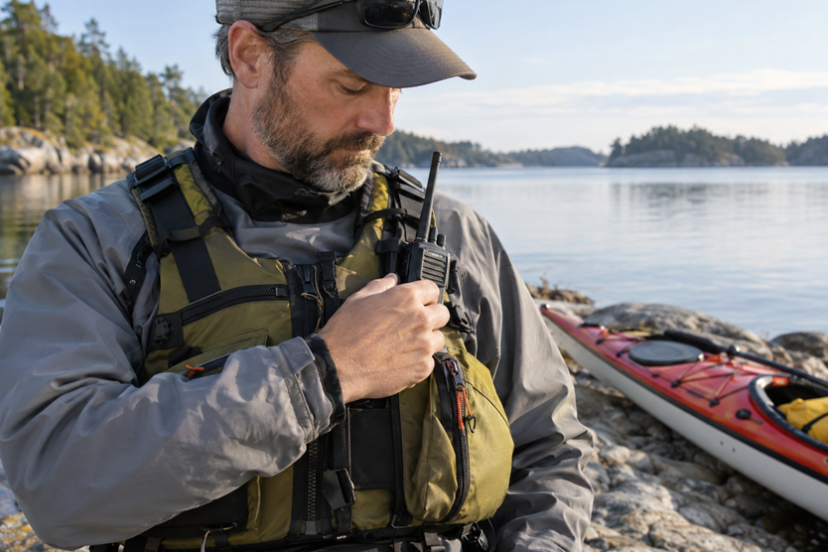
A handheld marine VHF radio can be an important communication tool for coastal kayakers, but choosing one is not simply a matter of buying the radio with the highest transmit power or the longest feature list.
For kayaking, the radio needs to work within a much bigger safety system: your paddling skills, weather judgment, route planning, personal flotation device, clothing, ability to self-rescue, and decision about when conditions are beyond your limits.
The right handheld VHF is one you can keep accessible, operate with wet or cold hands, protect from immersion, keep charged, and understand well enough to use when communication actually matters.
Quick Buying Answer
For most coastal kayakers considering a handheld marine radio, prioritize:
- A genuinely waterproof marine-rated design
- Flotation or another reliable way to prevent losing the radio
- Easy access to marine VHF Channel 16
- Controls you can operate quickly
- Enough battery capacity for your expected trip
- A charging system that works with the way you travel
- A size and weight you will actually keep accessible on the water
Transmit power matters, but it should not dominate the decision. Marine VHF communication is heavily influenced by antenna height, terrain, obstructions, and line of sight. That is particularly relevant in a kayak because the radio antenna sits relatively close to the water.
For paddlers who specifically want Digital Selective Calling (DSC) and integrated GPS, look for a handheld designed around those capabilities rather than assuming every marine VHF includes them. The U.S. Coast Guard notes that DSC distress alerts can include position information when the radio has an internal GPS or is connected to one.
When A Handheld Marine Radio Helps
A handheld VHF becomes particularly relevant when your kayaking takes you onto coastal bays, sounds, large estuaries, near-shore ocean routes, or other waters where marine traffic and shore-based marine communications are present.
Unlike an ordinary phone call, a marine VHF transmission can potentially be heard by other vessels monitoring the same channel as well as appropriate shore stations.
The U.S. Coast Guard identifies VHF-FM radio as a preferred method for reporting emergencies from vessels on the water and directs mariners to Channel 16 for distress and calling communications.
A radio can also provide access to NOAA weather channels and marine information on models equipped for them.
That makes a handheld VHF useful for more than emergencies. Depending on where you paddle, it can help you monitor marine communications and weather information before a situation becomes urgent.
What A Handheld VHF Cannot Do
A radio does not make difficult conditions appropriate for your skill level.
It cannot compensate for:
- Poor weather judgment
- Insufficient cold-water protection
- Weak self-rescue skills
- An unsuitable kayak
- Inadequate route planning
- Separation from your group
- Failure to wear a suitable PFD
- Paddling farther offshore than your experience supports
It also does not guarantee that someone will hear every transmission.
VHF coverage depends substantially on antenna height, terrain, receiving-station location, and propagation conditions. Coast Guard Rescue 21 coverage modeling specifically accounts for line of sight and terrain when estimating VHF reception.
A handheld radio should therefore be treated as one communication layer, not as permission to take greater risks.
1. Start With Waterproofing And Flotation
A marine radio carried in a kayak should be chosen with immersion in mind, not merely rain.
Two common ratings in handheld marine radios are IPX7 and IPX8.
For example, Standard Horizon specifies the HX210 as IPX7, including submersion to approximately 1 meter for 30 minutes. Icom gives the same IPX7 immersion specification for the IC-M25 EVO. Uniden rates the Atlantis 275 to IPX8.
The rating matters, but so does what happens after you drop the radio.
A floating radio is especially useful from a kayak because retrieving a sinking electronic device during a capsize is unrealistic.
Even with a floating model, consider how you will carry it. A radio stored deep inside a hatch may remain dry but become inaccessible exactly when you need it.
For coastal paddling, accessibility deserves almost as much attention as waterproofing.
2. Consider Carryability, Not Just Specifications
A handheld radio that looks manageable on a store shelf can feel different once it is attached to a PFD for several hours.
Think about:
- Weight
- Thickness
- Button size
- Antenna position
- Belt clip or attachment arrangement
- Whether it interferes with paddling
- Whether you can reach it with either hand
The Icom IC-M25 EVO, for example, is specified at approximately 8 ounces and 2.2 × 5.3 × 1.2 inches, excluding projections. Icom also emphasizes larger controls and a textured grip intended for easier handling.
That kind of compact design may appeal to a paddler who wants the radio carried directly on a PFD rather than stored elsewhere on the kayak.
Do not choose solely from a specification sheet, though. Your PFD pocket arrangement, body position, hydration system, tow system, and other equipment all affect whether a particular radio is convenient.
3. Look At Transmit Power In Context
The examples in this guide transmit at either 5 or 6 watts at their highest setting.
The Standard Horizon HX210 provides selectable 6W, 2.5W, and 1W settings. The Icom IC-M25 EVO provides approximately 5W, 2.5W, and 1W. The Uniden Atlantis 275 is rated for 6W transmit power.
It can be tempting to turn that into a simple conclusion that 6 watts automatically means meaningfully greater usable range.
That is too simplistic.
Marine VHF is strongly affected by radio horizon and antenna height. From a kayak, your antenna may be only a few feet above the water, while the antenna of a shore station or larger vessel may be much higher. Terrain such as headlands and islands can also affect reception.
So consider transmit power, but do not treat a one-watt difference as the deciding factor between otherwise suitable radios.
4. Pay Attention To Battery And Charging
A radio is useful only if it has power when needed.
Before choosing one, think about the way you actually paddle.
For a day paddler who returns home after every outing, a conventional charging cradle may be perfectly convenient.
For multi-day trips or travel where power banks are already part of the charging system, USB charging may be more useful.
The Standard Horizon HX210 uses an internal 1850 mAh lithium-ion battery and is supplied with a desktop charging cradle along with AC and 12-volt DC charging arrangements.
The Icom IC-M25 EVO instead uses USB Type-C charging. Icom states that it can also be charged from a user-supplied portable battery, although USB Power Delivery is not supported. Its Eco Mode reduces transmit output to 2.5W and is rated for approximately 14 hours under Icom’s stated test cycle.
Neither approach is automatically superior.
Choose the charging arrangement that fits your travel and paddling routine.
5. Think About Visibility And Recovery If You Drop It
Flotation is useful. Flotation combined with a way to locate the radio can be even more useful.
The Standard Horizon HX210 incorporates a water-activated emergency strobe. Standard Horizon states that the light can activate when the radio enters the water, including with an appropriate setting when the radio itself was turned off.
The Icom IC-M25 EVO uses the company’s Float’n Flash function: the radio floats and can flash and sound an alarm after entering the water.
Uniden lists an emergency strobe and flashlight among the Atlantis 275’s features.
Those features do not replace securing the radio properly, but they can make a dropped radio easier to identify.
6. Decide Whether You Want Basic Voice VHF Or DSC/GPS
This is an important distinction that can easily be lost when comparing product listings.
A conventional handheld marine VHF allows voice communication on marine channels, including access to Channel 16.
The U.S. Coast Guard identifies Channel 16 as the international distress, safety, and calling channel.
A DSC-equipped radio adds digital calling capability. When properly configured, a DSC distress radio with position information can transmit a digital distress alert. The Coast Guard specifically recommends GPS capability when purchasing a new DSC marine radio because position information can then accompany the distress alert.
The current manufacturer specifications for the HX210, IC-M25 EVO, and Atlantis 275 emphasize conventional handheld VHF functions and do not list integrated GPS/DSC among their features.
If integrated GPS and DSC are priorities for your coastal paddling, expand your search to radios specifically designed with those capabilities rather than choosing one of these three simply because it is otherwise a good handheld.
Matching The Radio To Your Paddling
The useful question is not, “Which radio has the most features?”
It is, “Which radio fits the way I paddle?”
Day Trips And Straightforward Coastal Paddling
A relatively simple floating VHF with straightforward controls, NOAA weather reception, and quick Channel 16 access may provide everything you realistically intend to use.
The advantage of simplicity is that you can become familiar with the controls quickly.
That matters more than owning functions you have never practiced using.
Frequent Travel Or Multi-Day Trips
Charging flexibility becomes more important when you are away from your normal charging setup.
A USB-C-equipped radio may integrate more naturally into a kit that already includes a power bank and other USB-powered equipment.
Battery management should become part of your pre-launch routine rather than something you think about after reaching the water.
More Exposed Coastal Routes
As your trips become more remote or exposed, the question should not simply become, “Which VHF should I buy?”
Your entire communication strategy deserves attention.
Depending on the route, paddler, and environment, that may mean considering additional communication or distress-signaling equipment, better route planning, group procedures, training, and a radio with capabilities beyond a simple voice-only handheld.
More electronics should support better preparation—not encourage more aggressive route choices.
Three Handheld Marine Radio Examples
These examples illustrate different feature combinations within the same basic product category. They are not rankings, and no claim of personal testing is being made.
Standard Horizon HX210 6W Floating Handheld Marine VHF Transceiver
May be a good fit for:
Paddlers who want a conventional floating marine VHF with straightforward controls, 6W maximum transmit output, and a water-activated visual recovery feature.
Why it may fit:
The HX210 is rated IPX7, floats, provides selectable 6W/2.5W/1W transmit settings, receives NOAA weather channels, and includes quick access to Channel 16. Its water-activated strobe can help make the unit easier to locate after it enters the water.
Its supplied charging equipment includes a desktop cradle along with AC and 12V DC charging options.
Things to consider:
The charging arrangement is more traditional than USB-C charging. Think about whether a cradle-based system fits the way you travel and recharge equipment.
Check the Standard Horizon HX210 on Amazon
Icom IC-M25 EVO Floating Handheld VHF Marine Transceiver
May be a good fit for:
Paddlers who prioritize relatively light carry weight, USB-C charging, and controls designed to remain manageable in wet conditions.
Why it may fit:
Icom specifies the IC-M25 EVO at approximately 8 ounces. It floats, uses Float’n Flash for recovery visibility, carries an IPX7 rating, and offers approximately 5W/2.5W/1W transmit power. It also includes weather channels and quick Channel 16 access.
USB-C charging may be particularly convenient for paddlers who already carry a compatible power bank.
Things to consider:
Its maximum rated transmit output is 5W rather than 6W, although the practical usefulness of a handheld VHF should not be judged by that specification alone. Antenna position, terrain, and line of sight remain major factors.
Check the Icom IC-M25 EVO on Amazon
Uniden Atlantis 275 Handheld VHF Marine Radio
May be a good fit for:
Paddlers who want a floating 6W handheld with a higher IPX8 submersion rating and a large display.
Why it may fit:
Uniden lists the Atlantis 275 as a floating handheld with 6W transmit output, NOAA emergency weather channels, U.S., Canadian, and international marine channels, an emergency strobe and flashlight, and IPX8 waterproof construction.
It is supplied with a charging cradle, belt clip, wrist strap, antenna, AC adapter, and DC adapter.
Things to consider:
As with the HX210, consider whether its cradle-style charging arrangement works with your normal trip routine. Also determine how comfortably the radio fits your preferred PFD or on-body carry position.
Check the Uniden Atlantis 275 on Amazon
Common Buying Mistakes
Choosing By Maximum Wattage Alone
A 6W label can look more impressive than 5W, but transmit power is only one factor in VHF communication.
Antenna height and the path between transmitting and receiving antennas matter greatly.
Do not turn one specification into the entire buying decision.
Buying A Waterproof Radio And Then Storing It Out Of Reach
A perfectly protected radio inside a sealed hatch does little good if you cannot reach it after a capsize or while managing difficult conditions.
Plan your carry location before buying.
Assuming Floating Means Impossible To Lose
A floating radio can still drift away.
Flotation should be combined with thoughtful attachment and accessibility.
Buying Features You Have Never Learned To Use
More functions can be useful, but only if you understand them.
Whatever radio you choose, learn the basic controls before launching, including:
- Power
- Volume
- Squelch
- Channel selection
- Transmit power selection
- Channel 16 access
- Weather functions
- Scanning or watch functions you intend to use
If you paddle with a group, it also helps to establish communication procedures before leaving shore.
Treating The Radio As A Substitute For A Good Decision
This is the most important mistake to avoid.
A VHF radio should not turn marginal weather into acceptable weather or make an exposed route appropriate for a paddler who is not prepared for it.
The safest radio call may be the one you never need to make because you changed the route, delayed the trip, or turned around earlier.
Are There Simpler Alternatives?
For protected paddling very close to shore, some paddlers may decide that a waterproof phone carried securely on their person is sufficient for their particular situation.
But a phone and a marine VHF perform different jobs.
The Coast Guard notes that VHF communications can be received by nearby vessels as well as shore stations, while a cellular phone functions primarily as a point-to-point connection through the cellular network.
For coastal environments where marine communication is relevant, a phone can be a useful additional communication method rather than an automatic replacement for VHF.
Conversely, carrying a VHF does not mean every kayaker needs the most sophisticated marine radio available.
Match the equipment to the water you actually paddle.
Final Decision Checklist
Before buying a handheld marine radio for coastal kayaking, ask:
- Am I actually paddling waters where marine VHF communication is useful?
- Is the radio designed to withstand immersion rather than just occasional splashing?
- Does it float, or do I have a dependable way to secure it?
- Can I carry it where I can reach it immediately?
- Can I operate the important controls with wet or cold hands?
- Does the charging system fit my day trips, travel, or multi-day paddling?
- Am I comfortable with a conventional voice VHF, or do I specifically want GPS and DSC?
- Will I learn Channel 16 procedures and practice basic radio operation before depending on it?
- Am I choosing features I will realistically use?
- Would additional training, better preparation, or a more conservative paddling plan solve the underlying problem better than another piece of equipment?
A handheld marine radio can be a valuable addition to a coastal kayaking setup. The goal is not to own the most impressive radio. It is to carry an appropriate communication tool, understand its limitations, and know how to use it while continuing to make sound decisions on the water.