The biggest safety mistakes beginners make while kayak fishing usually come from treating the kayak like…
Biggest Beginner Mistakes In Kayak Fishing
The biggest beginner mistakes in kayak fishing usually come down to trying to fish before learning how to manage the kayak itself. New kayak anglers often focus on rods, tackle, and where the fish might be, but the real problems usually start earlier: poor setup, weak positioning, limited awareness, rushed decisions, and treating a fishing kayak like a stable little boat instead of a small craft that still demands judgment.
That does not mean kayak fishing has to feel intimidating. It just means success usually comes from staying simpler than you think, moving more deliberately than you want to, and remembering that control matters more than convenience.
For many beginners, the experience feels a little more scattered than expected. You are trying to paddle, steer, manage gear, watch the wind, avoid tangles, keep balance, and fish at the same time. On calm water that can already feel like a lot. Add current, boat wake, changing weather, or a cluttered deck, and small mistakes start stacking quickly.
The first mistake is bringing a full fishing mindset into a small-craft situation
A lot of beginners approach kayak fishing as if they are simply downsizing from bank fishing or boat fishing. They assume the main adjustment is less space. In reality, the bigger adjustment is that the kayak changes every decision.
In a kayak, your position moves more easily. Your casting angles are different. Your body weight matters more. Reaching for gear can affect stability. Wind and current can quietly move you off target while you are focused on fishing. Even landing a fish can become awkward if the kayak is not under control.
This is why the best beginner mindset is not “How do I bring everything I need?” It is “How do I keep this day simple enough to stay in control?”
That single shift helps a lot of other problems fall into place.
Too much gear creates more trouble than it solves
One of the most common beginner mistakes is overloading the kayak with rods, crates, tools, extra tackle, electronics, and accessories before learning what is actually useful on the water.
This usually comes from good intentions. Beginners want to be prepared. But too much gear can make a kayak feel crowded, unstable, and distracting. It also makes it harder to move cleanly, harder to re-enter if something goes wrong, and easier to lose important items overboard.
In practice, extra gear often creates three problems at once. It adds clutter. It reduces mobility. It divides attention.
For a beginner, a simpler setup usually leads to better fishing and better judgment. Fewer items on deck means fewer snags, fewer rushed reaches, and fewer moments where something small turns messy.
A helpful reframe here is that kayak fishing efficiency is not about bringing more options. It is about removing enough friction that you can paddle, position, and fish without chaos.
Many beginners underestimate how much boat control affects fishing
A common frustration in kayak fishing is feeling like you cannot stay where you want to fish. Beginners often assume the problem is lack of skill with the rod or bad luck with fish. Often the real issue is poor boat control.
If the kayak keeps drifting, turning, swinging sideways, or sliding off structure, everything becomes harder. Your casts become rushed. Your lure presentation gets less consistent. Your attention goes to correction instead of reading the water.
This matters for safety too. Poor positioning near docks, shorelines, current seams, launch areas, or other boats can create unnecessary pressure and poor decisions. When people feel behind the kayak, they tend to rush. Rushing in a fishing kayak often leads to unstable movement, dropped gear, and bad judgment.
One of the most useful things a beginner can understand is that fishing from a kayak is often more about position management than fishing aggression. The paddler who stays controlled usually gets more workable opportunities than the paddler who keeps fighting the kayak.
Standing too early can turn confidence into avoidable trouble
Standing in a fishing kayak gets a lot of attention, and some beginners assume it is an expected part of kayak fishing right away. But standing is not a skill badge. It is only useful when conditions, kayak design, and personal balance all support it.
Many new kayak anglers try standing before they have spent enough time learning how their kayak reacts to small weight shifts, turns, and reaching motions. What feels stable at rest can feel very different when you turn to grab a rod, set the hook, look over your shoulder, or get surprised by wake.
The mistake is not standing itself. The mistake is treating it like a milestone instead of a situational choice.
A beginner who stays seated and controlled is usually making the better call than a beginner who stands just because the kayak seems stable in flat, quiet water for a few minutes.
Launching and landing are often sloppier than beginners expect
A lot of people picture kayak fishing as the time spent casting and landing fish, but beginner mistakes often happen before the fishing even starts or right after it ends.
Launching and landing can feel awkward because they combine gear handling, shallow water movement, footing, and timing. That is where rods get snagged, paddles drift away, balance gets compromised, and people step out too quickly or in the wrong place.
These moments matter because they happen when attention is divided. The paddler is half focused on the shoreline and half focused on protecting gear. That split attention is where preventable mishaps live.
A useful clarification is that smooth kayak fishing days often begin with calm, boring launches and end the same way. If those transitions feel rushed or cluttered, the rest of the outing usually feels harder too.
Beginners often fish water that asks too much of them
Another major mistake is choosing conditions based on fishing ambition instead of paddling readiness. A beginner may want to reach farther water, fish open areas, cross windy sections, or launch somewhere that looks productive without fully understanding what the route or return trip will feel like.
This is one of the easiest mistakes to make because the water can look manageable from shore. But wind, current, fatigue, distance, and changing conditions often feel different once you are exposed and committed.
The problem is not just discomfort. It is that harder conditions reduce margin. Small gear problems become bigger. Positioning gets tougher. Decision-making gets narrower. The paddler becomes more reactive and less observant.
This is why “fishable” and “wise for a beginner” are not always the same thing.
A calmer, smaller, more manageable outing is not a compromise. For a beginner, it is often the fastest path to building real confidence.
Poor deck organization makes simple tasks feel harder
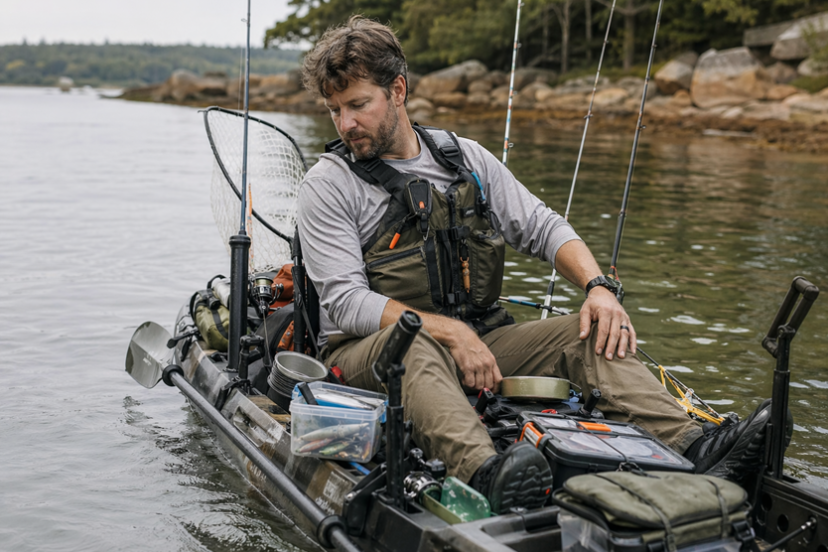
Beginners are often surprised by how much little movements matter in kayak fishing. Reaching behind you, twisting to grab pliers, shifting for a tackle box, or managing a loose net can all feel minor on land but noticeably less smooth in a kayak.
A disorganized deck creates constant friction. It also increases the odds of hooks catching where they should not, lines tangling around gear, and paddlers making unstable reaches because something essential was placed badly.
This is not about making the kayak look neat. It is about preserving calm movement.
When your most-used items are accessible and everything else is minimized, you free up attention for what matters. When gear is scattered, every task becomes slightly more awkward, and awkwardness tends to pile up.
New kayak anglers sometimes confuse confidence with readiness
Kayak fishing content can make the sport look easy, polished, and gear-driven. That can lead beginners to think they are ready for more complexity once they own the right kayak or accessories. But confidence built on equipment tends to feel strong right up until conditions or decision-making get more demanding.
Readiness is quieter than that. It shows up in how calmly you launch, how simply you rig, how early you notice drift, how well you protect your balance, and how willing you are to keep the day smaller when conditions are off.
That is an important distinction because beginners do not usually get in trouble from one dramatic error. More often, they string together several normal-looking choices that slowly reduce their margin.
In other words, beginner mistakes in kayak fishing are often accumulation mistakes.
The safest beginner approach is usually the least flashy one
The most reliable early progress in kayak fishing usually comes from a setup and approach that may feel almost too simple.
That means manageable water, limited gear, realistic time on the water, stable positioning, calm launches, and a willingness to spend part of the outing just learning how the kayak behaves while fishing. None of that sounds exciting, but it builds the kind of comfort that supports better fishing later.
There is also a reassuring truth here: many beginner mistakes are normal because kayak fishing combines two skill sets at once. You are not just learning how to catch fish. You are learning how to function well in a paddle craft while doing it. That is why early awkwardness does not mean you are bad at it. It usually means you are still learning which part of the day deserves your attention first.
The clearer you are about that, the easier it becomes to improve.
A better first goal is control, not complexity
If you are new to kayak fishing, the most helpful first goal is not maximizing gear, distance, or fish count. It is learning to keep the day calm enough that you can stay aware, stable, and deliberate.
That usually means fewer rods, fewer moving parts, easier water, and better respect for positioning, launch transitions, and changing conditions. Once those pieces feel normal, the fishing side tends to open up more naturally.
Beginner mistakes in kayak fishing are common because the sport looks more straightforward than it really is. But most of those mistakes become easier to avoid once you understand the bigger pattern: when the kayak starts controlling the day, everything gets harder. When you stay in control of the kayak, the whole experience becomes safer, clearer, and more enjoyable.

More to Explore